FLEARAIL BLOG
3rd April 2026
As most of the armed forces museums are closed during the winter, I have spent much of the winter on tasks other than FLEARAIL.
With it being Easter weekend, museums are awakening from their hibernation so I will be visiting a number over the coming months to see if any have information relating to railways.
I keep an eye on e-bay for suitable items, either to add to my collection or some times I can just capture an image. One such opportunity occurred today with the appearance of a 1943 rail/bus map owned by a member of the USAAF, from a seller in the USA the cost would be over £60. Therefore I have taken a screen image and added details to the FLEARAIL web-site.
One of the ongoing tasks I am involved in is the Great Eastern Railway Society "Picture Digitisation Working Group" and I was fortunate at their last working day to be cataloguing a batch of images that included 3 official LNER publicity photo's from 1943. One is of special interest as it is of a an armoured F4 (no 7071) at Stratford on 22nd September 1943.
21st October 2025
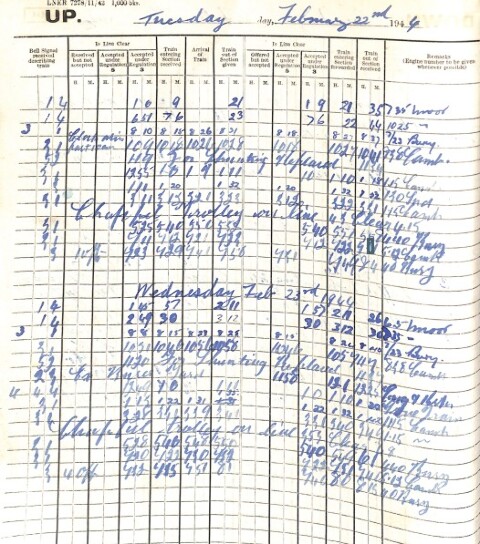
While working with the East Anglian Rail Museum on their WW2 display I borrowed the Bures Signal Box registers for the period around D-day. At 12:49 on Wednesday February 23rd 194, the bell code 4-4-4 was received from Sudbury. Against this the signalman has written "Grove Train", this being the telegraphic code for the Royal Train.
So what was the Royal Train doing in the area?
My first port of call for such questions is the British Newspaper Archive
The Reuters's account, published in a number of newspapers read "British invasion troops, waiting to open the second front, have shown their paces to the King who last night completed a two-day visit to army units “somewhere in England’’.
Following that up I looked at the Build up to D-day web-site to look for possible sites.
Then a visit to the TNA Discovery search engine found the war diaries of the Northumberland Signal's and a RAMC detachment confirming the visit.
Questions still remain:
Where did the Royal Train come from and go to, while in East Anglia?
Where was it stabled overnight?
What coaches were in the train?
The National Railway Museum in York does have a file on this trip, which I will need to arrange to see when I next visit.