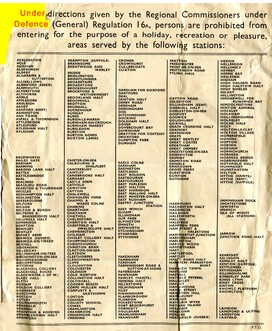
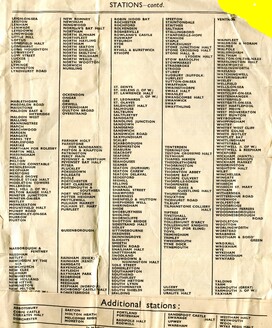
Poster Displayed At Stations Listing Prohibited Areas
The Evacuation Paradox
In “Essex at war” an account of World War two in and around East Essex, Hervy Benahm refers to the “evacuation paradox”.
“In September 1941 over 13,000 vulnerable people left [the Colchester and Tendring area] in special trains and the paradoxical position was reached that Colchester was at once a neutral area, an evacuation area and a reception area. The special train parties went to Kettering, Wellingborough, Stoke on Trent and Burton on Trent.”.
What Benham did not know at the time of writing his book was that the evacuation of vulnerable people from the East Coast was a very small element in a plan for a much bigger evacuation.
File AN2/28 at the National Archives which is entitled “CRASH EVACUATION BY RAIL IN CASE OF AN INVASION TAKIG PLACE IN ANY PARK OF GREAT BRITAIN” indicates the size of the operation. For example, 12 trains were allocated to the Hunstanton branch. In most cases the trains would not run from the coast but the evacuees would be entrained elsewhere:
- Kings Lynn – Magdelen Road
- Norwich – Wymondham
- Ipswich – Haughley (or Long Melford / Sudbury)
- Colchester - Chapel and Wakes Colne
- Chelmsford - Shenfield
- Southend – Pltsea (possibly Wickford)
Through the research of Jaki Collison of the EARM we can see the arrangements for trains from Chappel.
The trains would be made up of Westinghouse braked 8 coach suburban sets hauled by V1 engines, departing Chapel at hourly intervals. The trains were to be routed to Stratford and then up the Lee Valley to gain the Tottenham and Hampstead Junction Railway at South Tottenham, the destination was Junction Road station (closed 1943).
Whereas file AN2/28 is concerned with the railway operating aspects of the evacuation AN 2/22 gives us a picture into the human side.
Although the titles of AN2/28 refers to a crash evacuation, it was intended that certain essential personnel would remain in the area. To this end planning started in late 1940 to discuss evacuation from coastal town but the first detailed minutes seen are for a meeting a meeting that was held at Cambridge on the 5th September 1941 to consider what proportion of railway staff should remain behind in coastal areas. The outcome was an agreement that the following numbers would remain:
Felixstowe 52, Clacton, Frinton and Walton 90, Kirby Cross 4, Thorpe-le-Soken 7, Aldeburgh 26, Lowestoft 186, Lowestoft Harbour 175, Yarmouth and Gorleston 271, Southend and Prittlewell 111, Maldon 7, Harwich/Parkeston & Dovercourt 193, Harwich (Marine Supt. ) 218, Harwich (Electrical & Telegraph) 80.
Of great concern was the feeding of those who remained behind and this is discussed at some length in the meetings. In most cases railway staff would be catered for a communal sites that were being established for all essential personnel but at Lowestoft, Yarmouth, Harwich and Colchester the railway authorities were expected to do the cooking and serving of meals.
For those being evacuated the police would be required to escort then to the station and ensure that all the trains were correctly loaded, the railway staff would only be responsible for the prompt dispatch of each train. It was anticipated that 1,600 people would board each train. In total 258,600 people would have to leave their homes.
Although invasion never occurred, evidence in archive indexes indicate that it came within three weeks of being implemented. [1]
The plan was not discontinued until October 1944.
As a footnote to this story the ERAM collection contains a very rare example of a memorandum sent staff on 12th November 1941, It is addressed to: Clerk W.C. Hunt at Clacton and reads:
ARRANGEMENTS FOR EVACUATION
This is to notify you that you are required to remain for duty at Clacton until you are otherwise instructed by the Company.
In order to facilitate catering after the Evacuation the evacuation of the Civilian Population, you will be expected to equip yourself with a knife, fork, spoon, plate, cup or mug.
1. NRM catalogue entry “2004-8190”